

Finding the right immigration lawyer for a work visa or company sponsorship can feel overwhelming. Whether you are a foreign professional seeking employment in the United States or a business owner looking to sponsor international talent, the stakes are high. A single filing error can cause costly delays or outright denials. This guide breaks down the most common work visa categories, explains the employer sponsorship process, and shows you exactly what to look for in an experienced immigration attorney so you can move forward with confidence.
What Is an Immigration Lawyer?
An immigration lawyer is a licensed attorney who specializes in advising individuals and businesses on visa applications, residency petitions, compliance audits, and deportation defense under federal immigration law. Unlike general practitioners, immigration attorneys stay current on rapidly changing USCIS policies, processing times, and regulatory updates.
At BridgehouseLaw, our immigration law attorneys provide strategic legal solutions for businesses and individuals navigating U.S. immigration processes. The firm assists international companies expanding into the U.S. market as well as professionals seeking lawful permanent residency.
Common U.S. Work Visa Types at a Glance
A work visa is a government-issued authorization that allows a foreign national to live and work in the United States for a specific employer and duration. Choosing the right category is the first critical step. Below is a comparison of the most frequently used employment-based visa types.
| Visa Type | Who It Is For | Duration | Employer Sponsorship Required? |
|---|---|---|---|
| H-1B | Specialty occupation workers (e.g., engineers, IT professionals) | 3 years, extendable to 6 | Yes |
| L-1A | Intracompany transferees in executive or managerial roles | Up to 7 years | Yes |
| L-1B | Intracompany transferees with specialized knowledge | Up to 5 years | Yes |
| E-2 | Treaty investors from qualifying countries | 2 years, renewable | No (self-sponsored) |
| O-1 | Individuals with extraordinary ability or achievement | Up to 3 years | Yes (or agent) |
L-1 visas are temporary, non-immigrant, employment-based visas reserved for company employees who hold management or executive positions or have specialized knowledge. BridgehouseLaw assists with L-1, H-1B, and E-2 visa applications for companies expanding into the U.S. market.
How Company Sponsorship Works
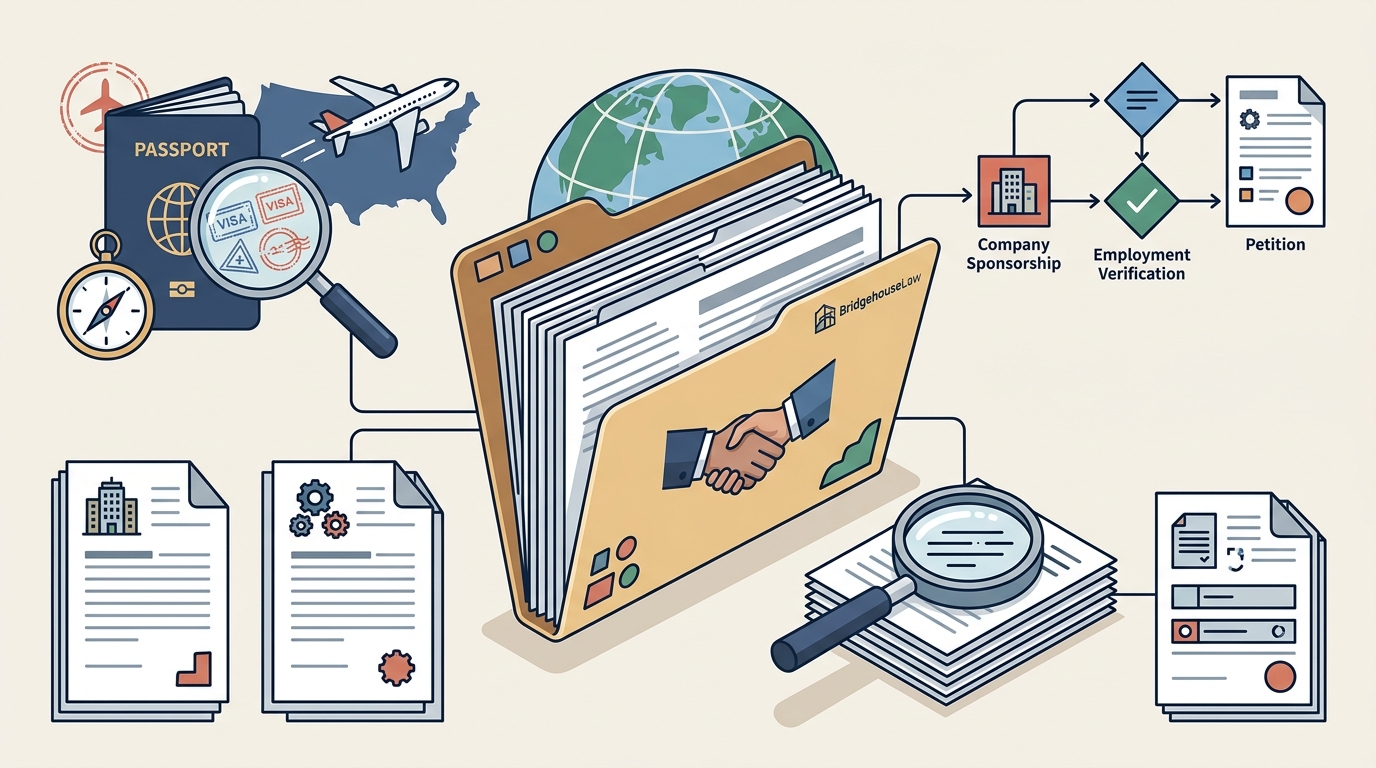
Company sponsorship is the formal process by which a U.S. employer petitions the federal government to hire a foreign worker for a specific role. The employer files the necessary petition with USCIS and, for certain visa categories, must first obtain a certified Labor Condition Application (LCA) from the U.S. Department of Labor.
Steps in the Sponsorship Process
- Job offer: The employer extends a qualifying job offer to the foreign worker.
- LCA filing: For H-1B visas, the employer submits an LCA confirming prevailing wage compliance.
- Petition filing: The employer files Form I-129 (or I-140 for green card sponsorship) with USCIS.
- Adjudication: USCIS reviews and approves or denies the petition.
- Consular processing or adjustment of status: The worker obtains the visa stamp abroad or adjusts status if already in the U.S.
Ensuring compliance with wage and labor regulations under the Department of Labor is essential when sponsoring foreign workers. BridgehouseLaw's business immigration lawyers guide employers through every step to avoid penalties.
Why You Need an Immigration Lawyer
Immigration law is one of the most complex areas of federal law, with rules that change frequently through executive orders, USCIS policy memos, and court decisions. According to the American Immigration Lawyers Association (AILA), even minor errors on forms can lead to Requests for Evidence (RFEs) that delay cases by months.
Risks of Filing Without Counsel
- Missed deadlines that result in status lapses
- Incorrectly classified visa petitions
- Wage violations that trigger DOL audits and fines
- Denial with no clear path to appeal
An experienced immigration attorney tailors strategies to each unique case, helping you avoid these pitfalls. BridgehouseLaw offers personalized strategies because every immigration case is unique.
What to Look for in an Immigration Attorney
Not all lawyers handle immigration matters. When evaluating an attorney, consider the following criteria.
Experience with Your Visa Category
Ask whether the firm regularly handles H-1B, L-1, or E-2 cases. A firm with a track record in corporate law and U.S. market entry will understand the intersection of business formation and immigration better than a generalist.
International Reach
If your company operates across borders, look for a firm with offices in multiple jurisdictions. BridgehouseLaw maintains offices in Atlanta, Charlotte, Berlin, Cologne, Guatemala City, Sao Paulo, and Vancouver, giving clients direct access to attorneys who understand both U.S. and international legal systems.
Client Reviews and Track Record
Look for verified client testimonials. BridgehouseLaw clients have praised the firm's expertise and genuine commitment to helping them secure green cards and work authorizations.
Employer Compliance and I-9 Audits
An I-9 audit is a review of the Employment Eligibility Verification forms that every U.S. employer must complete for each employee. Compliance with U.S. immigration laws is critical to avoid costly penalties. BridgehouseLaw's immigration law attorneys assist with I-9 audits, ensuring accurate documentation and records for all employees.
The firm also advises on obligations under visa sponsorship programs, such as wage requirements and labor conditions. Employers who fail to maintain proper records risk fines ranging from $252 to over $2,500 per violation under ICE enforcement guidelines.
Key Takeaways
- An immigration lawyer specializes in visa petitions, compliance, and residency applications under federal immigration law.
- The H-1B, L-1A, L-1B, E-2, and O-1 are the most common work visa categories for professionals and executives.
- Company sponsorship requires the employer to file petitions, meet wage requirements, and comply with DOL regulations.
- Filing without legal counsel significantly increases the risk of costly delays, RFEs, or outright denials.
- Choose an attorney with direct experience in your visa category and a proven record of employer sponsorship cases.
- I-9 compliance audits are essential for every U.S. employer and should be reviewed by legal counsel regularly.
- An international law firm with multi-jurisdictional offices can streamline cross-border immigration needs.
Frequently Asked Questions
What does an immigration lawyer do for work visas?
An immigration lawyer evaluates your eligibility, prepares and files visa petitions with USCIS, responds to Requests for Evidence, and represents you during interviews or appeals. They also advise employers on compliance with DOL wage and labor regulations.
How much does it cost to hire an immigration lawyer?
Fees vary based on the visa type and case complexity. H-1B petitions typically involve attorney fees between $2,000 and $5,000, plus USCIS filing fees that can exceed $2,000. Many firms offer flat-fee arrangements for standard filings.
Can my employer sponsor me for a green card?
Yes. Employer-sponsored green cards follow a multi-step process that includes a PERM labor certification, an I-140 petition, and an adjustment of status or consular processing. BridgehouseLaw facilitates green card applications to transition temporary visa holders into permanent residency.
What is the difference between an H-1B and an L-1 visa?
An H-1B visa is for specialty occupation workers hired by a U.S. employer, while an L-1 visa is for intracompany transferees moving from a foreign office to a U.S. affiliate. L-1 visas do not require a labor certification, making them faster in many cases.
How long does the work visa process take?
Processing times depend on the visa category and USCIS workload. Standard H-1B processing takes 3 to 6 months, while premium processing delivers a decision within 15 business days for an additional fee. L-1 petitions generally take 1 to 3 months without premium processing.
Do I need an immigration lawyer if my company has an HR department?
Yes. HR departments handle internal policies, but immigration law requires specialized legal knowledge. An immigration attorney ensures petitions are legally sound, deadlines are met, and the company remains compliant with federal regulations.
Can BridgehouseLaw help international companies enter the U.S. market?
Absolutely. BridgehouseLaw specializes in helping international businesses with U.S. market entry, from incorporating a subsidiary to securing work visas for key personnel. The firm's practice areas cover corporate law, immigration, employment law, and more.
What happens if my visa petition is denied?
If your petition is denied, your attorney can file a motion to reopen or reconsider with USCIS, or appeal to the Administrative Appeals Office (AAO). In some cases, refiling with additional evidence is the most effective strategy.
Schedule Your Consultation
Whether you are an employer preparing to sponsor international talent or a professional seeking a U.S. work visa, the right legal guidance makes all the difference. BridgehouseLaw's experienced immigration law attorneys are ready to help you navigate the process efficiently and compliantly. Contact BridgehouseLaw today to schedule a consultation and take the first step toward your immigration goals.