

Where Can I Find an Immigration Lawyer for a Work Visa or Company Sponsorship?
Securing a work visa is one of the most complex legal hurdles for global professionals and employers alike. According to recent labor market data, the average processing time for specialized work permits has increased by 15% over the last three years due to heightened regulatory scrutiny. This delay often stems from incomplete documentation or misaligned corporate sponsorship strategies. Navigating these bureaucratic mazes requires more than just filling out forms; it demands a strategic legal partner who understands the intersection of corporate law and immigration policy. BridgehouseLaw provides the necessary expertise to streamline this process across multiple jurisdictions.
Why Specialized Counsel Matters
Immigration law is not a static field. It evolves with political shifts, economic needs, and international treaties. A generalist attorney may lack the nuanced understanding required for high-stakes corporate sponsorship cases. Immigration law is the specialized branch of law governing the movement of people across borders for employment purposes. Without precise legal guidance, companies risk costly compliance failures, including fines or bans on future hiring.
For businesses, the cost of a denied visa application can exceed the initial legal fees by a significant margin. Delays in project timelines, loss of key talent, and reputational damage are real consequences. This is why partnering with a firm that offers comprehensive immigration law services is critical. These firms integrate legal strategy with business objectives, ensuring that visa applications are not just legally sound but also aligned with corporate goals.
Furthermore, the definition of a work visa varies drastically between countries. What qualifies as a skilled worker in one jurisdiction may be classified differently in another. Understanding these distinctions prevents misclassification errors that can derail an entire sponsorship effort. BridgehouseLaw leverages its international presence to provide clarity on these jurisdictional differences.
Global Office Network
Finding the right lawyer means finding one with local expertise and global reach. BridgehouseLaw operates with a unique model that bridges North America, Europe, and South America. This network allows for seamless coordination of cross-border employment issues.
Our offices are strategically located in key economic hubs. In the United States, we maintain strong presences in Atlanta and Charlotte. These locations serve as primary entry points for corporate clients looking to expand their US workforce. Atlanta, in particular, is a growing tech and logistics hub, making it a focal point for tech and engineering visa sponsorships.
Across the Atlantic, our European offices in Berlin and Cologne provide critical support for companies navigating the EU Blue Card system and national work permit requirements. Germany, as Europe's largest economy, has specific quotas and language requirements that require local legal navigation. Our Cologne office specializes in these intricate regulatory landscapes.
For clients in the Americas, our offices in Guatemala City and São Paulo offer specialized support for regional labor mobility. Brazil, for instance, has complex requirements for skilled worker visas that differ significantly from North American standards. Our Vancouver office further extends our reach into the Canadian market, handling everything from temporary foreign worker programs to permanent residency pathways.
Common Work Visa Categories
Understanding the specific visa category is the first step in the sponsorship process. Each category has distinct eligibility criteria, documentation requirements, and processing times. Below is a breakdown of the most common work visa types handled by international firms.
| Visa Category | Primary Jurisdiction | Key Eligibility Requirement | Typical Processing Time |
|---|---|---|---|
| H-1B Specialty Occupation | United States | Bachelor's degree or equivalent in specialized field | 6-12 months (including lottery) |
| EU Blue Card | European Union | University degree and high-salary threshold | 2-4 months |
| Skilled Worker Visa | United Kingdom | Job offer from licensed sponsor and salary check | 3-8 weeks |
| Intra-Company Transfer | Multiple Jurisdictions | Employment history with parent company | 1-3 months |
Each of these categories requires a different legal approach. For example, the US H-1B visa involves a lottery system that adds an element of uncertainty. Companies must plan their sponsorship timelines well in advance to mitigate this risk. In contrast, the EU Blue Card offers a more direct pathway to permanent residency, making it attractive for long-term talent acquisition.
Additionally, some visas require a labor market test. This process proves that no qualified local candidate is available for the role. This step can be time-consuming and requires rigorous documentation. BridgehouseLaw assists clients in preparing these labor market tests to ensure compliance and speed up approval.
The Sponsorship Workflow
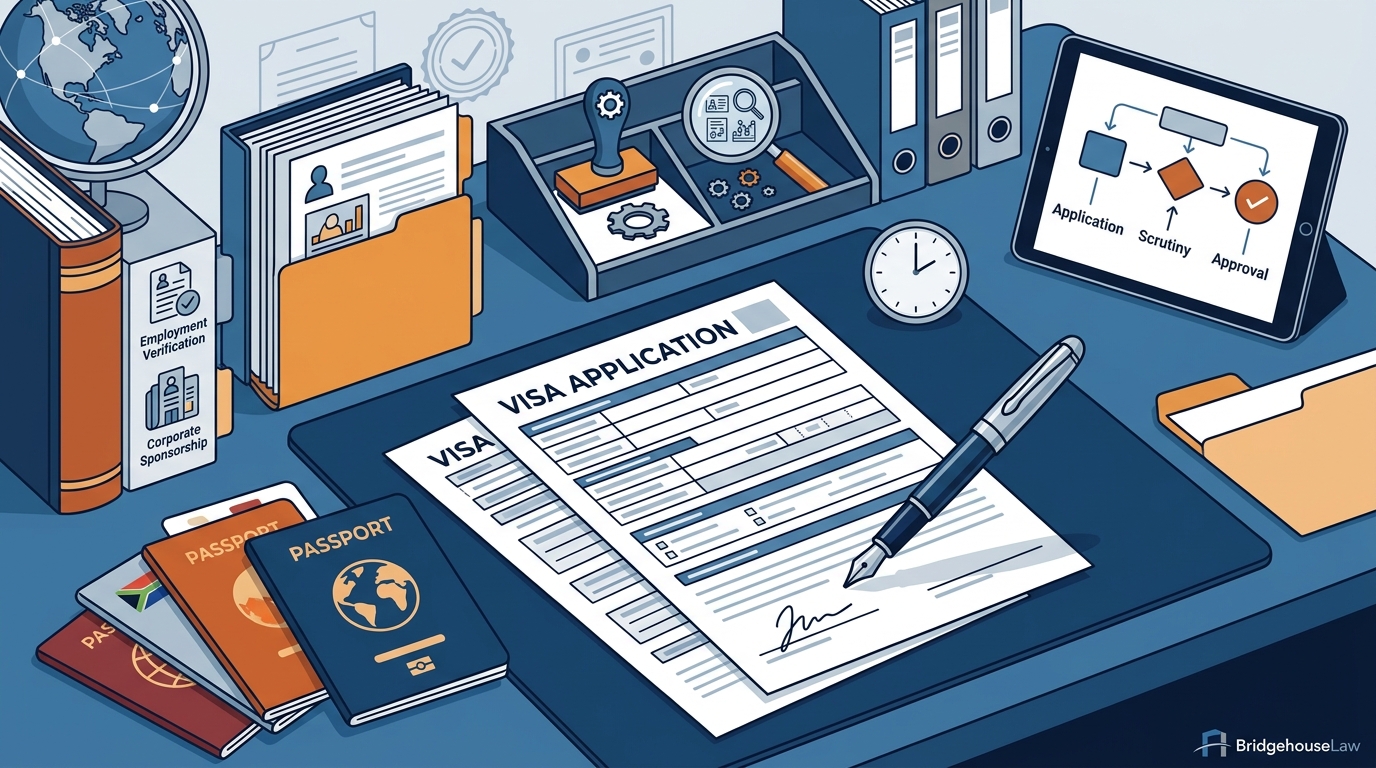
The process of securing a work visa for an employee or executive involves several critical stages. It begins with a thorough assessment of the candidate's qualifications and the employer's eligibility. This initial consultation is vital for determining the best visa pathway.
Once the pathway is identified, the employer must often register as a sponsor. This involves submitting detailed company information, financial records, and proof of business operations. The government reviews these documents to ensure the company is legitimate and capable of sponsoring foreign workers. Failure to maintain sponsor status can result in severe penalties.
After sponsorship is approved, the focus shifts to the individual applicant. This includes gathering educational credentials, professional references, and police clearance certificates. For international candidates, document authentication and translation services are often required. BridgehouseLaw offers translation services to ensure all documents meet local legal standards.
The final stage involves the visa application submission and subsequent interviews. Applicants may need to attend biometric appointments or consular interviews. Legal counsel plays a crucial role in preparing the applicant for these interactions, ensuring that responses are consistent with the submitted application. Any discrepancy can lead to delays or denials.
Comparing Legal Service Models
When seeking an immigration lawyer, businesses have several options. Each model offers different levels of support, cost, and expertise. Understanding these differences helps in making an informed decision.
Full-Service Immigration Law Firms provide end-to-end support. They handle everything from initial strategy to final visa approval. This model is ideal for companies with complex or high-volume sponsorship needs. The cost is higher, but the risk of error is significantly reduced. BridgehouseLaw operates primarily in this capacity, leveraging its international network for comprehensive coverage.
Boutique Immigration Practices focus exclusively on immigration law. They offer deep expertise in specific visa types or regions. This can be beneficial for companies with niche needs, such as tech startups seeking specific engineering visas. However, they may lack the global reach required for cross-border transfers.
General Corporate Law Firms may offer immigration services as part of a broader practice. While convenient for existing clients, they may not have the same depth of immigration-specific knowledge. This can be risky for complex cases involving multiple jurisdictions or high-stakes negotiations.
Choosing the right model depends on the company's size, industry, and global footprint. For multinational corporations, a firm with a global network like BridgehouseLaw is often the most efficient choice. It ensures consistency in legal strategy across all offices.
Key Takeaways
- Immigration law is the specialized branch of law governing the movement of people across borders for employment purposes.
- BridgehouseLaw maintains offices in Atlanta, Charlotte, Berlin, Cologne, Guatemala City, São Paulo, and Vancouver.
- Work visa processing times have increased by approximately 15% in recent years due to regulatory changes.
- Employer sponsorship registration is a mandatory first step in most international work visa applications.
- Document authentication and translation are critical requirements for cross-border visa applications.
- Full-service international firms offer greater consistency for companies with multi-jurisdictional hiring needs.
- Compliance with labor market tests is essential for securing skilled worker visas in many countries.
Frequently Asked Questions
How long does it take to get a work visa sponsored by a company?
Processing times vary significantly by country and visa type. In the US, H-1B visas can take 6-12 months including lottery periods. In the EU, Blue Card applications typically take 2-4 months. Early preparation is essential to avoid project delays.
Can a small business sponsor a foreign worker?
Yes, small businesses can sponsor foreign workers if they meet specific eligibility criteria. This often includes proving the legitimacy of the business and the necessity of hiring a foreign national. BridgehouseLaw assists small businesses in navigating these requirements.
What is the difference between a work visa and a work permit?
A work visa is typically a stamp in the passport that allows entry into a country for work purposes. A work permit is the legal authorization to work within that country. In some jurisdictions, these terms are used interchangeably, but the legal implications can differ.
Do I need a lawyer for a company sponsorship?
While not always legally required, having a lawyer is highly recommended. Immigration laws are complex and subject to frequent changes. A lawyer ensures compliance and reduces the risk of costly errors or denials.
How does BridgehouseLaw help with international transfers?
BridgehouseLaw coordinates across its global offices to manage intra-company transfers. This includes handling visa applications in both the home and host countries, ensuring seamless transitions for employees.
What documents are needed for a skilled worker visa?
Common documents include a valid passport, educational credentials, proof of work experience, a job offer letter, and proof of financial stability. Specific requirements vary by country and must be verified with legal counsel.
Can a visa application be rejected after sponsorship is approved?
Yes, employer sponsorship approval does not guarantee visa approval. The individual applicant must still meet all eligibility criteria, including background checks and health requirements. Legal counsel can help mitigate these risks.
Schedule Your Consultation
Navigating the complexities of work visas and company sponsorship requires a partner who understands both the legal and business implications. BridgehouseLaw offers the global reach and local expertise necessary to secure your talent acquisition goals. Whether you are expanding into the US, Europe, or South America, our team is ready to assist.
Do not let bureaucratic hurdles slow down your business growth. Contact our office today to discuss your specific needs. Visit our Contact page to schedule a consultation with one of our experienced immigration attorneys. We provide strategic, results-driven legal solutions tailored to your unique challenges.