

Global mobility has become a critical strategic component for both multinational corporations and skilled professionals seeking new opportunities. According to recent international labor market data, the demand for cross-border talent has accelerated, with over 280 million international migrants recorded globally in recent years. This surge highlights the complexity of navigating diverse legal systems. For businesses expanding into new markets, understanding the nuances of immigration law is not just a compliance requirement but a competitive advantage. This guide compares the primary immigration pathways in the United States, Canada, and Germany, focusing on corporate needs, skilled worker visas, and long-term residency options. (Contact Bridgehouse Law)
US Immigration Framework and Corporate Visas
The United States remains the top destination for international business expansion and high-skilled employment. However, its immigration system is notoriously complex, relying heavily on employer sponsorship for work authorization. For international companies establishing a U.S. subsidiary, the initial hurdle is often securing the right legal structure and visa categories for key personnel.
The L-1 Intracompany Transferee Visa
The L-1 visa is a cornerstone for multinational corporations. It allows companies to transfer managers, executives, or employees with specialized knowledge from a foreign office to a U.S. branch. This pathway is critical for maintaining operational continuity during market entry. The process requires demonstrating a qualifying relationship between the foreign and U.S. entities, ensuring that the transfer is not merely a new hire but a strategic internal movement.
The H-1B Specialty Occupation Visa
For hiring new talent directly in the U.S., the H-1B visa is the most common route. It is designed for specialty occupations that require theoretical and practical application of highly specialized knowledge. The annual cap and lottery system create significant uncertainty for employers. Consequently, many firms turn to alternative visas or structure their hiring strategies around the L-1 or O-1 visas for individuals with extraordinary ability.
BridgehouseLaw assists international businesses with U.S. market entry by providing expert guidance on company setup, immigration support, and HR compliance. Our attorneys ensure a seamless transition for your team, whether you are forming an LLC or securing visas for your key staff. Learn more about our Corporate Law Services.
Canada’s Points-Based Immigration System
Canada has positioned itself as a welcoming destination for skilled immigrants and investors, utilizing a transparent, points-based system. This approach prioritizes factors such as age, education, language proficiency, and work experience. For businesses, this means a more predictable pipeline of talent compared to the lottery-based systems in other jurisdictions.
Express Entry and Provincial Nominee Programs
The Express Entry system manages applications for three federal economic immigration programs: the Federal Skilled Worker Program, the Federal Trades Program, and the Canadian Experience Class. Candidates are ranked using the Comprehensive Ranking System (CRS). Those with the highest scores receive invitations to apply for permanent residence. Additionally, Provincial Nominee Programs (PNPs) allow individual provinces to nominate candidates who meet their specific labor market needs. This is particularly useful for businesses in British Columbia or other regions seeking specialized talent.
Work Permits for Employers
For companies hiring foreign workers temporarily, the Temporary Foreign Worker Program (TFWP) and the International Mobility Program (IMP) are essential. The IMP often utilizes Labour Market Impact Assessments (LMIA) exemptions, such as for intra-company transfers or significant benefit applicants. Understanding these nuances is vital for maintaining a stable workforce in Canada.
Our Vancouver office specializes in assisting skilled professionals, investors, and families migrating to Canada. We provide comprehensive support for corporate transactions, immigration, and employment law. Visit our Vancouver office details to see how we support Canadian business expansion.
Germany and the DACH Region Legal Landscape
Germany serves as the economic engine of Europe, making it a prime target for international business expansion. The German immigration system has recently undergone significant reforms to attract skilled workers from outside the EU. The focus is on addressing labor shortages in critical sectors such as IT, engineering, and healthcare.
The EU Blue Card
The EU Blue Card is a residence permit for highly qualified non-EU citizens. It allows holders to live and work in Germany and, after a certain period, move to another EU country. The requirements include a university degree and a job offer with a minimum salary threshold. This card is particularly attractive for tech professionals and engineers looking for long-term stability in the DACH region.
The Skilled Immigration Act
Recent changes to the Skilled Immigration Act have lowered barriers for vocational training holders and IT specialists without degrees but with significant experience. This shift reflects Germany’s pragmatic approach to talent acquisition. Companies expanding into Germany must navigate these regulations carefully to ensure compliance with local labor laws and tax implications.
BridgehouseLaw’s German offices in Berlin and Cologne provide full-service legal and business consulting for companies expanding to Germany, Austria, and Switzerland. We help you navigate market entry, compliance, and taxation. Explore our Business Law Services for detailed guidance on German corporate law.
Comparative Analysis of Key Visa Types
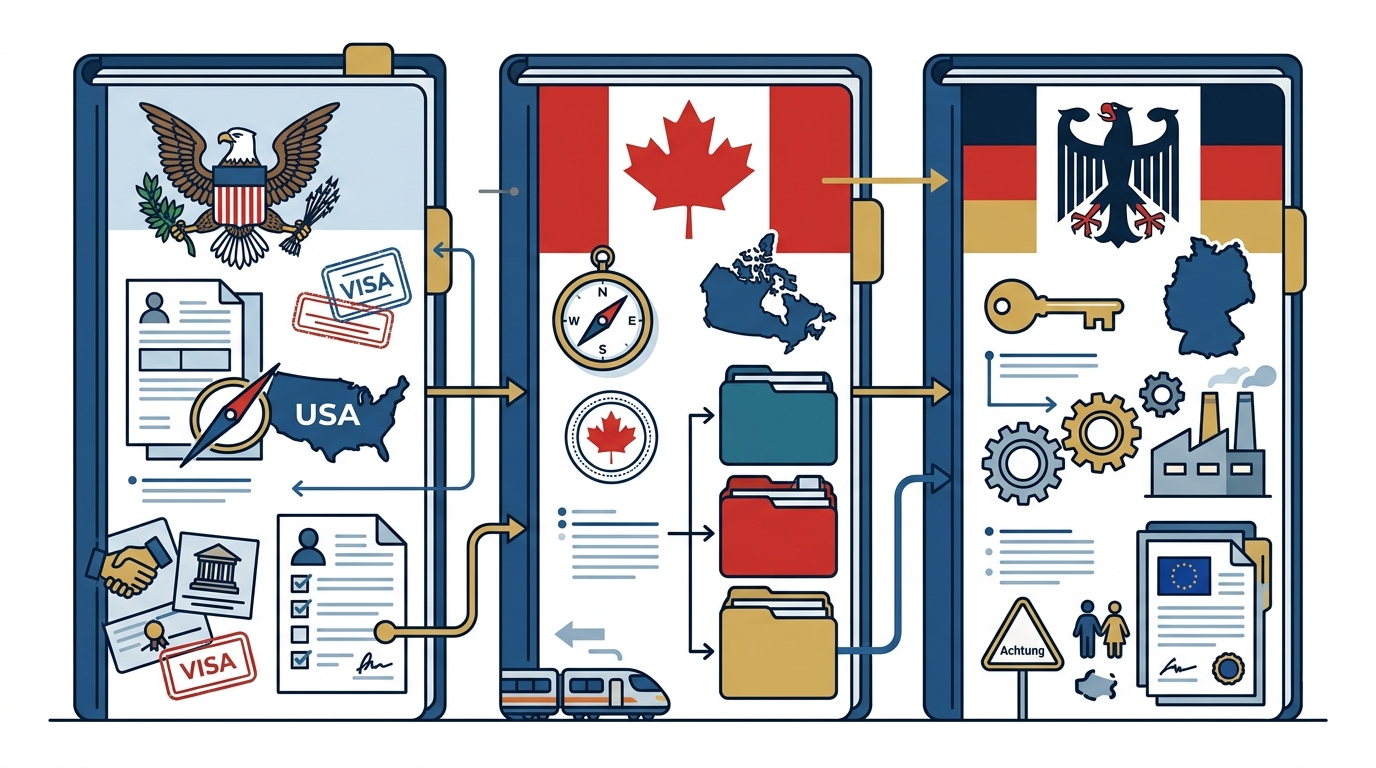
Choosing the right jurisdiction depends on your business goals, talent pool, and long-term strategy. The following table summarizes the key differences in immigration pathways across these three major markets.
| Feature | United States | Canada | Germany |
|---|---|---|---|
| Primary Work Visa | L-1, H-1B, O-1 | Express Entry, LMIA Work Permit | EU Blue Card, Skilled Worker Visa |
| Permanent Residency Path | Employment-Based Green Card (EB-2/EB-3) | Permanent Residence via Express Entry | Settlement Permit after 21-33 months |
| Key Advantage | Access to largest consumer market | Transparent, points-based system | Gateway to EU market with lower salary thresholds |
| Processing Time | Variable, often lengthy for Green Cards | Generally faster, 6-12 months | 6-12 months for Blue Card |
| Family Dependents | L-2, H-4 (Limited work rights) | Open Work Permit for spouses | Right to work after 6 months |
Each jurisdiction offers distinct benefits. The US provides unparalleled market access but complex visa hurdles. Canada offers a clear, merit-based path to residency. Germany provides a strategic entry point to the European Union with recent reforms favoring skilled labor. Contact our Immigration Law team to determine the best strategy for your organization.
Key Takeaways
- US Market Entry: The L-1 visa is essential for transferring key personnel from foreign offices to the US, ensuring operational continuity.
- Canadian Predictability: Canada’s Express Entry system offers a transparent, points-based approach to permanent residency for skilled workers.
- German Opportunities: The EU Blue Card provides a streamlined path to residency for highly qualified non-EU citizens in the DACH region.
- Compliance is Critical: Each jurisdiction has strict labor market testing and sponsorship requirements that must be met to avoid penalties.
- Strategic Planning: Early engagement with legal counsel can mitigate risks associated with visa denials and processing delays.
- Global Reach: BridgehouseLaw operates in Atlanta, Charlotte, Berlin, Cologne, Guatemala City, São Paulo, and Vancouver.
- Talent Retention: Understanding family dependent rights is crucial for employee satisfaction and retention in international assignments.
Frequently Asked Questions
What is the fastest way to immigrate to the US for business purposes?
The L-1 visa is often the fastest route for intracompany transferees, allowing managers and specialized knowledge workers to move to the US without the annual cap restrictions of the H-1B visa.
How does Canada’s Express Entry system work?
Express Entry is an online system that manages applications for three federal economic immigration programs. Candidates are ranked based on age, education, language skills, and work experience, with top-ranked individuals invited to apply for permanent residence.
Can I work in Germany without a degree?
Yes, recent reforms to the Skilled Immigration Act allow IT specialists and other skilled workers with vocational training or significant experience to qualify for work permits, even without a traditional university degree.
What is the EU Blue Card?
The EU Blue Card is a residence permit for highly qualified non-EU citizens that allows them to live and work in Germany and potentially other EU countries. It requires a university degree and a job offer meeting a minimum salary threshold.
Does BridgehouseLaw offer services in Latin America?
Yes, BridgehouseLaw has offices in Guatemala City and São Paulo, providing comprehensive legal services including corporate law, immigration, and litigation across Latin America and North America.
How can I open a US bank account as a foreign business owner?
BridgehouseLaw assists international clients with establishing US business bank accounts, providing the necessary documentation and corporate hosting services to facilitate this process.
What are the tax implications of hiring foreign workers in Canada?
Tax implications vary based on the worker’s residency status and the duration of their stay. Our Vancouver office provides guidance on compliance with Canadian tax laws for international employees.
Schedule Your Consultation
Navigating international immigration law requires precision, expertise, and a global perspective. Whether you are expanding into the US, Canada, or Germany, BridgehouseLaw is your trusted partner. Our multilingual legal team is ready to help you navigate cross-border legal matters, market entry, and compliance. Contact our office today to schedule a consultation and secure your global future.